
PRODUCT SPOTLIGHT
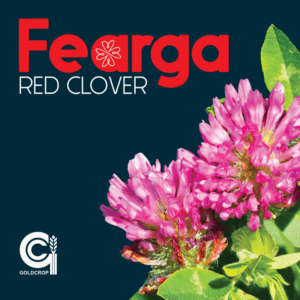
Fearga Red Clover
Fearga is the first-ever Red Clover variety to be bred under Irish conditions for Irish farmers. The breeding objectives of Fearga were to overcome poor yield and persistence to make Red Clover more reliable and attractive to use for farm systems. Fearga has proven better than the current standard in total yield and persistence. This is proven by independent results from the England and Wales recommended lists
By overcoming the challenges of red clover, Fearga will help increase Red Clover usage in our farm systems, reducing our dependence on imported chemical nitrogen and concentrate feeds. At such a crucial time, Fearga will better the environmental footprint of our animal production systems.
Fearga was bred using traditional breeding technologies. High performing Red Clover plants under Irish conditions and management were intercrossed at Teagasc OakPark, Carlow.

Growth Habit:
Red Clover has a tufted growth habit and a deep tap root, it does not have stolon’s like white clover. Rhizobia bacteria form nodules on the finer roots.
Silage
Expect 12-14t DM/ha/year. In the establishment, the year allows full flowering before harvest to aid root development for optimum N fixation. Normally 3-4 cuts per year at 6-8 week intervals from late May, after bud development but before flowering. Mower height no lower than 7cm. The crop should be wilted rapidly to 25-30% Dry matter. The leaf is prone to shatter so avoid excessive handling, advised not to use a conditioner mower. Advised to use an inoculant or acid to improve the fermentation, there are no natural lactic acid bacteria on red clover. The companion grass should have lactic acid bacteria and will supply sugar for fermentation.
Quality
Red Clover swards are high in protein and normally expect 60% to be true protein. Red Clover silage will usually have a crude protein content of 15-20%. It is highly digestible and highly palatable leading to high intake
Companion Grass
Will protect against poaching, improve the nutritional balance and improve the fermentation. Also helps to maintain the yields in years 2-4 and reduces weed ingress.
Grazing
Works best under moderate stocking rate and rotations of 4 weeks. Graze to 6cm. Otherwise its persistence is reduced. Graze carefully to protect growing crowns. Avoid poaching. Watch for bloat, introduce clover slowly, ensure livestock are fully fed when entering the field.
High levels of oestrogenic compounds
Works best under moderate stocking rate and rotations of 4 weeks. Graze to 6cm. Otherwise its persistence is reduced. Graze carefully to protect growing crowns. Avoid poaching. Watch for bloat, introduce clover slowly, ensure livestock are fully fed when entering the field.
Rotation
Avoid continuous Red Clover due to risk of Sclerotina disease (Clover Rot) and Stem Eelworm. Best advice is to have a 6 year break between crops. White clover is resistant to Clover Rot and the Stem Eelworm species that attacks red clover.
Soil Type
Well drained, fertile soils work best. Red clover is good for soil structure.
Fertiliser
Apply Phosphate and Potash, target maintaining at index 3 for P & K. Normally there is no Nitrogen to be applied. Exceptions are; at establishment on soils with very low Nitrogen status (tillage rotations) in which case apply 50kg/ha N and with an established crop on low nitrogen soils in a cold wet spring apply 30-50kg/ha N.
Lime
Maintain pH at 6.0-6.5.
Sowing
Sow from April to late July. It needs a fine, firm seed bed. Drill at 0.5-1cm deep (never deeper than 1.5cm) or broadcast. Use inoculated seed if sowing in areas where no clover has grown in recent years. Can over-sow
Seed Control
It is advisable to spray weeds 5-6 weeks after sowing with a suitable selective herbicide such as Clovermax or Legumex DB (apply once clover has one trifoliate leaf) to control seedling weeds particularly docks and thistles.
Sowing Rate
Red Clover will almost always be sown in mixtures with grass and possibly white clover. A number of Goldcrop Diamond mixtures cover different sward requirements and these are packed in acre packs. The sowing rates vary from 12.5kg to 13.5kg per acre depending on the mixture. In monoculture sow at 6kg/acre and expect an established crop with 200 plants per square metre.
Management
Graze lightly in the autumn of the sowing year. Expect 3-4 silage cuts per year starting in late May. Graze in the autumn. When cutting silage or applying slurry, it is important to avoid wheel damage to the red clover.
Pest and Disease
The two major problems are the disease Sclerotina (Clover Rot) and the Nematode ‘Stem Eelworm’. Sclerotinia causes a rot of the crown, leaves and stem. It is most evident in December and January and plants usually do not recover. Other diseases are Fusarium and Powdery mildew.
At establishment Slugs and Sitona Weevil can do damage, monitor the crop every few days and treat if necessary.
Red Clover Varieties
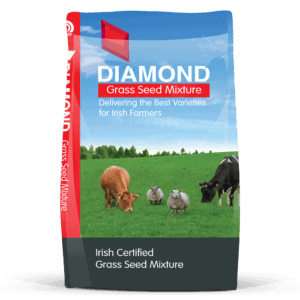

Diamond Red Clover Silage
| MOIRA | 3.50 KGS |
| FINTONA | 3.50 KGS |
| BARBLANCA - White Clover | 1.00 KGS |
| RED CLOVER | 4.00 KGS |
| 12.00 KGS PACK |
- Intensive silage mixture designed for 3-4 years
- Will continue as a normal grass sward afterwards
- White clover will fill spaces created by red clover dying out
- Produces high protein and high digestibility silage • Can be grazed but important not
to overgraze red clover
Sow at 12.0kg per acre
Diamond Red Clover & Hybrid PRG
| ASTONCRUSADER (HRG) | 9.00 KGS |
| BARBLANCA- WHITE CLOVER | 1.00 KGS |
| RED CLOVER | 4.00 KGS |
| 14.00 KGS PACK |
- Intensive silage mixture designed for 2-3 years
- Produces higher short term yields than perennial mix
- White clover will fill spaces created by red clover dying out
- Produces high protein and high digestibility silage
- Can be grazed but important not to over graze red clover
- Suitable for multi cut silage
Sow at 14.00kg per acre
Diamond Red Clover Grazing – N Saver
| ASTONENERGY | 5.00 KGS |
| ASTONCONQUEROR | 5.00 KGS |
| RED CLOVER | 2.00 KGS |
| CRUSADER - WHITE CLOVER | 1.00 KGS |
| CHIEFTAIN- WHITE CLOVER | 1.00 KGS |
| 14.00 KGS PACK |
- Suitable for Intensive Grazing. AstonEnergy and AstonConqueror are 2 top performing grazing varieties score 5 and 4 stars for grazout on the 2022 Pasture Profit Index, a key trait to promote clover
- Can be grazed but important not to overgraze red
clover - Based on initial results where red clover gives early boost of N and white clover gives long lasting persistence
- Will fulfil the derogation requirement of sowing
1.5kgs/ha of red clover in silage swards
Sow at 14-16kg per acre
Ask a question
Goldcrop is committed to supporting our distributors and customers with regular market insights and education. If you wish to learn more about Maize, please complete the form below, and one of our team will contact you.