

Winter Barley Trial Plots at Shanagarry 4th February
As we move into February, the noticeable increase in daylight hours is welcomed by all of us. The plants in the fields are also beginning to respond and are benefitting from increased sunlight, temperature and drying opportunities.
This time last year, we were looking with disappointment at many crops that were damaged from rainfall and considering which of them would need to be replanted.
In contrast, winter crops this year are for the most part in much better condition and more complete thanks to better autumn planting conditions.
Winter Barley at Shanagarry
The winter barley trial plots at the Goldcrop trial site in Shanagarry were sown on the 3rd October on land that followed spring beans. This sowing date is about 10 days earlier than our normal sowing date at this location but with memories of 2023 still etched in our minds, we took advantage of the excellent soil conditions.
Similar progress was made through much of the country where growers wanted to ensure good establishment of their crops.
The winter barley crop established and grew well thanks to the mild autumn (see Temperature Table below) and took on the appearance of quite an advanced crop. One could be forgiven for thinking that the crop had begun stem extension before Christmas but on examination, it was obviously still in the vegetative phase albeit with longer leaves than normal which gave it a taller appearance.
Monthly Mean Air Temperature – Degrees C (source: Met Eireann, Roches Point, Cork)
| September | October | November | December | January | |
|---|---|---|---|---|---|
| 2024/25 | 14.1 | 12.4 | 10.3 | 8.6 | 6.6 |
| 2023/24 | 15.2 | 12.2 | 9.4 | 8.9 | 6.1 |
| Long Term Average | 13.9 | 11.4 | 8.9 | 7.4 | 6.8 |
Earlier varieties – earlier intervention
The advent of BYDV tolerant winter barley has been a great development for the crop, it allows growers to plant a little earlier while safe in the knowledge that the potential damage from BYDV is greatly lessened. Earlier planting has the benefit of getting through more planting when soil conditions are good; this lends itself to better establishment and is kinder to the soil.
The first BYDV tolerant varieties have been 6 row types, bred in France (for example Integral). These 6 row types are quicker developing and earlier to ripen than the 2 row British types that we have been used to.
The earlier development of these types leads to an earlier demand for the application of fertiliser in the spring and subsequent PGR when weather is suitable. Failing to apply nitrogen on time can result in loss of tillers and reduced yield.
At our southerly location, we commonly begin our first applications of Nitrogen to winter barley in the second half of February. This date can be 7-10 days later further north as spring growth doesn’t start as early.
It is not uncommon for a few weeks of dry weather to occur in early spring so getting the fertiliser applied that bit earlier should ensure that it is washed in should a dry spell occur.
This year, given the extra level of growth in many winter barley crops, it is likely that any residual nitrogen in the soil has already been utilised by the crop and timely application of nitrogen will be important to sustain the extra biomass that has been created in crops. The winter barley at the Goldcrop trial site received its first round of fertiliser on the 8th February this year. I would be happy to do it a week later, but I wanted to make use of the calm day and suitable ground conditions. This first split consisted of 370kg/Ha of 10.10.20 (30 units of N/acre). I aim to have all Nitrogen applied to the crop by GS30 (approx. mid March).
PGR will be applied during growthier conditions, this will be applied at approx. GS30-31 with the aim of evening out tiller size and shortening the early stem development.

[ Left to right ] 6 row versus 2 row – Growth habit comparison & Integral in vegetative phase – 4th February
Aphid Numbers
As part of the nationwide Teagasc Aphid Count Survery, We host aphid traps at the Goldcrop trial site. These traps are emptied every two weeks following crop emergence.
3 traps are placed in the crop at varying distances (10, 20 & 50m) from a hedge. The contents of each trap are analysed every two weeks and any aphids present are counted and identified.
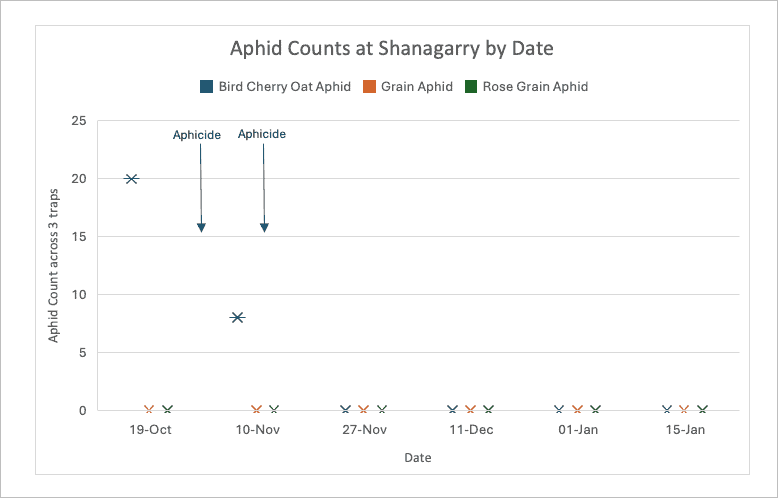
Two aphicides were applied to the crop at Shanagarry; while the surrounding crop is the BYDV tolerant variety Integral, the trials themselves contain many varieties which are not BYDV tolerant, and it is essential that these varieties are protected in such a mild autumn.
Interestingly, the aphid counts reflect the impact of the aphicide application on aphid numbers. Aphid counts remained at zero following the second aphicide application, this indicates that no further aphid flight into the crop took place after mid November.
The counts are shown in the following table

Aphid Traps & Application of fertiliser to Goldcrop trial plots – 8th February
 Article by John Dunne, Goldcrop Ltd.