Skip to content
  • Link to X Link to X Link to X
  • Link to Facebook Link to Facebook Link to Facebook
  • Link to LinkedIn Link to LinkedIn Link to LinkedIn
  • Link to Youtube Link to Youtube Link to Youtube
  • CROPTALK BLOG
  • Shopping Cart Shopping Cart
    0Shopping Cart
Goldcrop
  • Forage Seed
    • Grass Seed
      • Grass Seed Mixtures
      • White Clover
      • Red Clover
    • Maize & Beet
      • Maize
      • Beet
    • Brassica Fodder Crops
      • Fodder Rape Crop
      • Kale Crop
      • Swedes Crop
      • Stubble Turnips Crop
    • Breeding
      • Teagasc Forage Breeding Program
  • Arable Seeds
    • Cereals
      • Cereal Varieties Recommended Lists
      • Barley
      • Oats
      • Wheat
      • Triticale
      • Hybrid Rye
    • Catch Crops
      • Catch Crop Mixtures
    • Oilseed Rape
      • Winter Oilseed Rape
    • Pulses
      • Spring Beans
      • Winter Beans
      • Peas
  • Crop Protection
    • Adjuvant Range
    • Herbicide
    • Fungicide
    • Trace Element Range
    • Plant Growth Regulator
    • Insecticide
    • Slug Pellets
  • Amenity
  • Other Categories
    • Goldcrop Horticulture
    • Bird Food
    • Fencing
    • Lawn Seed
  • Resources
    • Croptalk Blog
    • Book a Speaker
    • Careers
    • Our Story
    • Goldcrop Catalogues
    • Contact Us
    • Agri Sales Team
    • Research and Development
      • Teagasc Forage Breeding Program
    • Goldcrop Partners Media Portal
  • Click to open the search input field Click to open the search input field Search
  • Menu Menu

Winter Cereal Varieties: “The Right Thing to Do is Still the Right Thing to Do”

Arable Seeds

As the dust settles on what was my 20th harvest, the mind begins to digest what was observed in 2026 while looking ahead to the next growing season.

This week, a winter cereal grower commented to me that he wasn’t sure if he had learned anything about varieties from harvest 2026. I know what he meant. 2026 was such an extreme year in terms of weather that varieties behaved somewhat differently from what we would expect in a “normal” year.

The DAFM Recommended List was published this past week. This highly anticipated document provides a wealth of information to help guide our variety choices for the coming autumn.

As someone whose job is to identify suitable varieties for Ireland, I never forget the consequences of a wet Irish harvest, such as those experienced in 2008, 2009 and 2012. I consistently gravitate towards wheat varieties with high KPH, resistance to sprouting and good resistance to lodging. In barley, I look for varieties with good straw strength and, of course, high yield potential.

I consider this to be the right thing to do. Even after the dry harvest of 2026, I believe that the right thing to do is still the right thing to do.
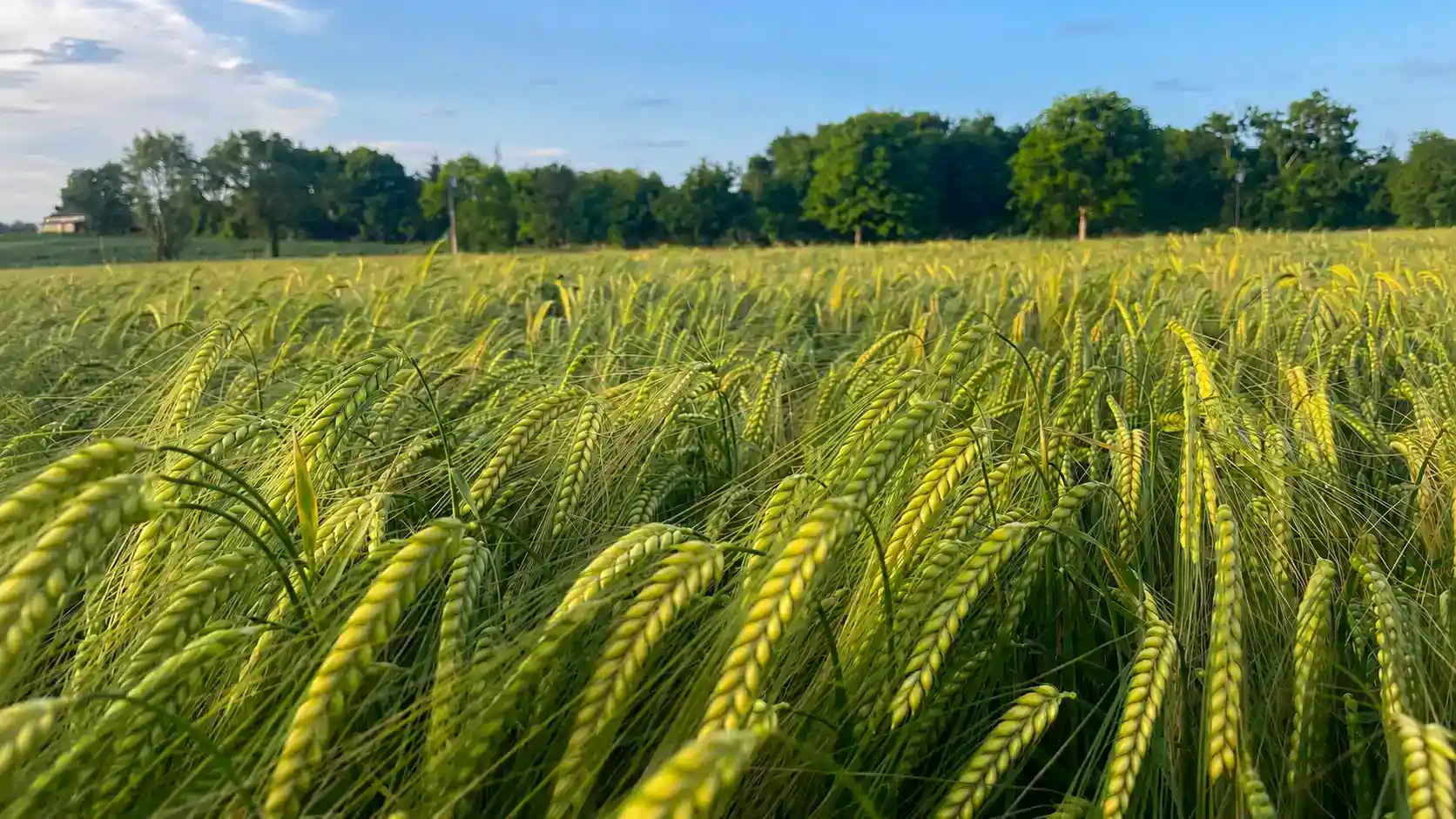
Winter Barley

Winter Barley


Integral

This high-yielding six-row variety has proven itself to be robust in tough winter conditions, tolerating waterlogging better than its competitors. Its BYDV tolerance provides added protection in a mild winter.

It is the highest-yielding non-hybrid variety on the Irish market.

Littoral

Littoral is a new six-row, BYDV-tolerant variety from Secobra, the same breeder as Integral. With scores of 8 for both Net Blotch and Rhynchosporium, it has excellent resistance to these wet-weather diseases.

Observations in Goldcrop trials have also shown Littoral to be relatively strong against Ramularia.

Littoral is slower developing than other BYDV-tolerant six-row varieties, making it easier to manage in early spring.

KWS Tardis

KWS Tardis has shown itself to be a reliable performer. Despite not having BYDV genetics, it is matching the yield of some of the newer BYDV-tolerant two-row varieties.

It also has very good straw strength, with scores of 6 for straw breakdown and 7 for lodging resistance.

Organa

Organa, a BYDV-tolerant two-row variety, is a new addition to the Recommended List. It offers improved yield over existing BYDV-tolerant two-row varieties while also having excellent all-round disease resistance, scoring 8 out of 9 for Rhynchosporium, Net Blotch, Mildew and Brown Rust.

It also has very good resistance to lodging, with a score of 7.
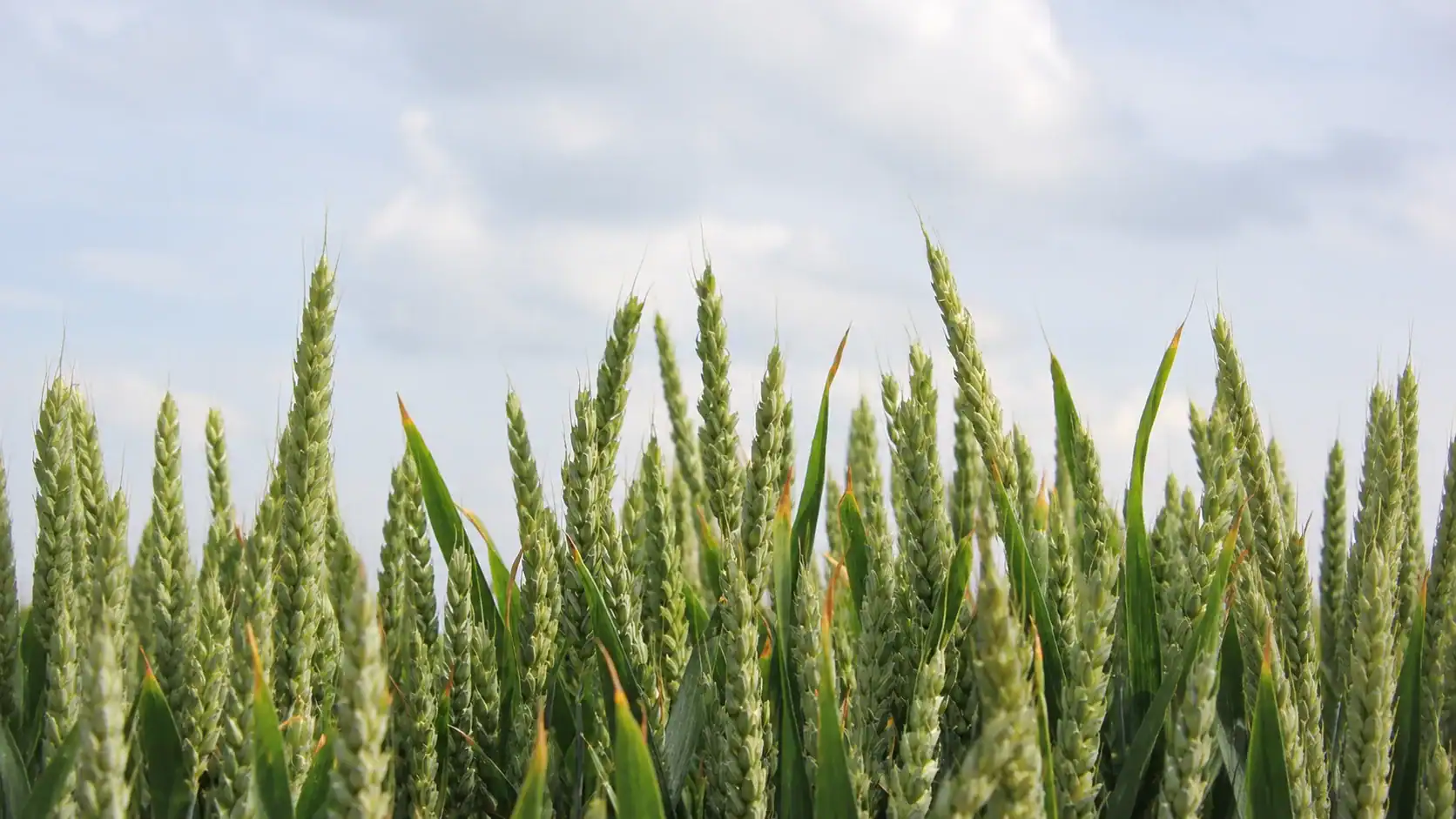
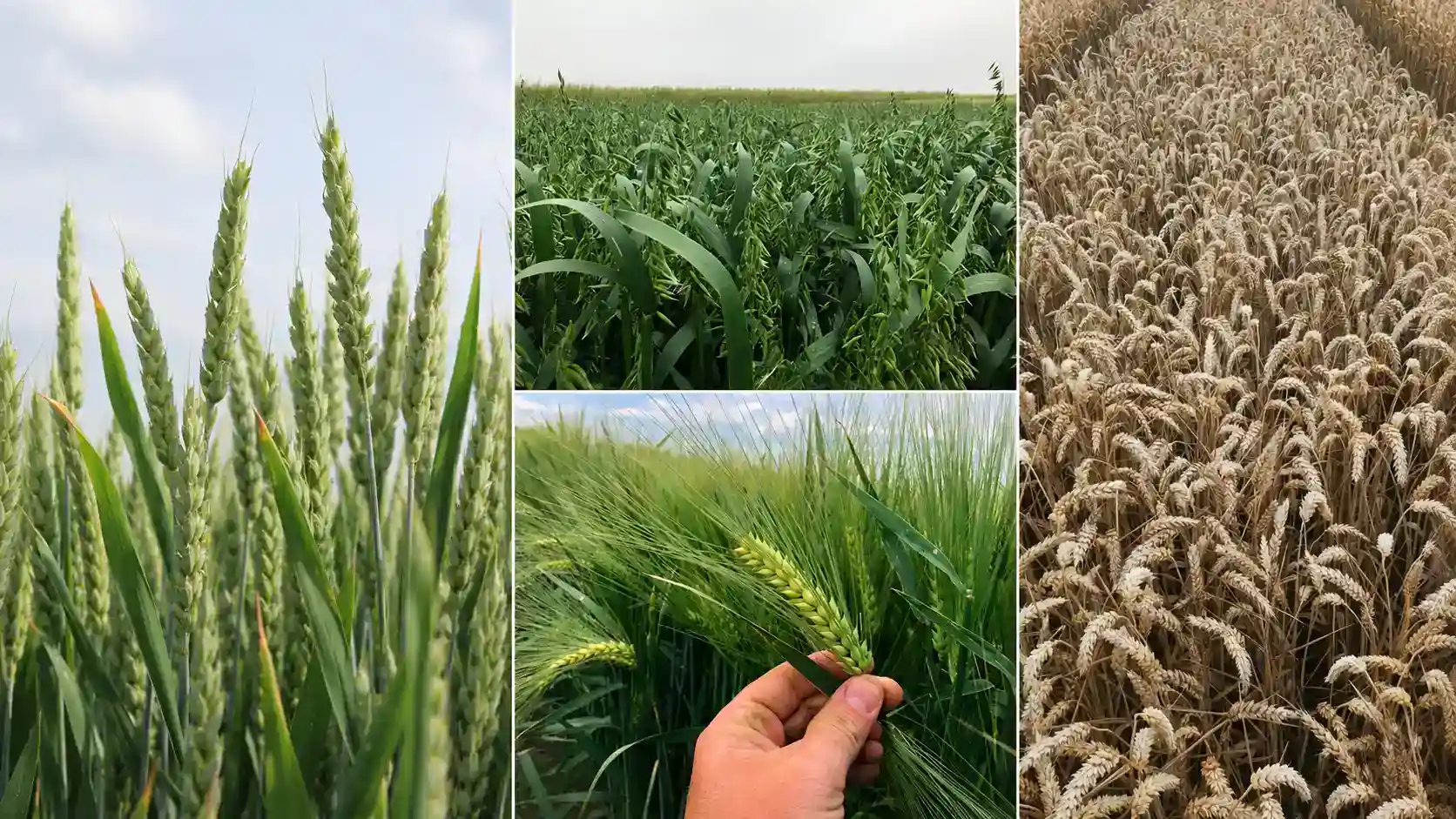
Winter Wheat

Winter Wheat


Winter wheat presents more potential agronomic challenges than winter barley. That said, by making full use of the range of information available on varieties, growers and agronomists can make informed choices suited to a particular region, soil type or sowing date.

Slow-Developing Varieties

Slower-developing varieties are the best choice where early sowing is required. They do not produce excessive biomass too early in the autumn and generally require less early intervention in the spring.

Two such varieties are RGT Hexton and KWS Scope.

RGT Hexton

RGT Hexton scores highly for straw strength, with scores of 7 for both lodging resistance and straw breakdown. It also has good resistance to sprouting, at 6 out of 9.

RGT Hexton is relatively strong against Yellow Rust, with a score of 6, while its Septoria and Mildew ratings are 5 and 7 respectively.

RGT Hexton has a noticeably slow rate of development in the autumn, where it tillers well and stays low to the ground.

With a yield rating of 100, RGT Hexton is equal to Graham in terms of yield potential.

KWS Scope

KWS Scope is similar to RGT Hexton in its growth habit — slow to develop in the autumn and well suited to early sowing.

KWS Scope is the second-highest-yielding variety on the List, with a yield rating of 103.

It also has very good straw strength, with scores of 7 for both lodging resistance and straw breakdown.

Where Scope requires some tailored attention is Yellow Rust. With a rating of 3, KWS Scope is a definite candidate for a T0 fungicide, as well as requiring careful monitoring throughout the season.

Quicker-Developing Wheat Varieties

These varieties develop more quickly in the autumn and are better suited to sowing from mid-October onwards. Their good genetic vigour also makes them appropriate choices for later sowing, particularly following root crops.

LG Rebellion

LG Rebellion is now fully recommended and has a high yield rating of 102.

It has excellent resistance to Yellow Rust, with a score of 7, alongside ratings of 5 and 7 for Septoria and Mildew respectively.

LG Rebellion also has excellent grain quality, with one of the highest KPH ratings on the List at 78.2. Reassuringly, it scores 7 for both lodging resistance and straw breakdown.

LG Rebellion is the only wheat variety on the market with PCH1 Eyespot resistance, this gives a very high level of resistance to True Eyespot.

WPB Fairview

WPB Fairview is a relatively new variety and will be eligible for addition to the Recommended List in 2027. Some seed is available this autumn.

The particular strengths of WPB Fairview are its very good straw strength and excellent grain quality. We expect it to have scores of 7 for both lodging resistance and straw breakdown, while also having the highest KPH on the Irish market.

WPB Fairview has indicative scores of 5 and 7 for Septoria and Yellow Rust respectively.
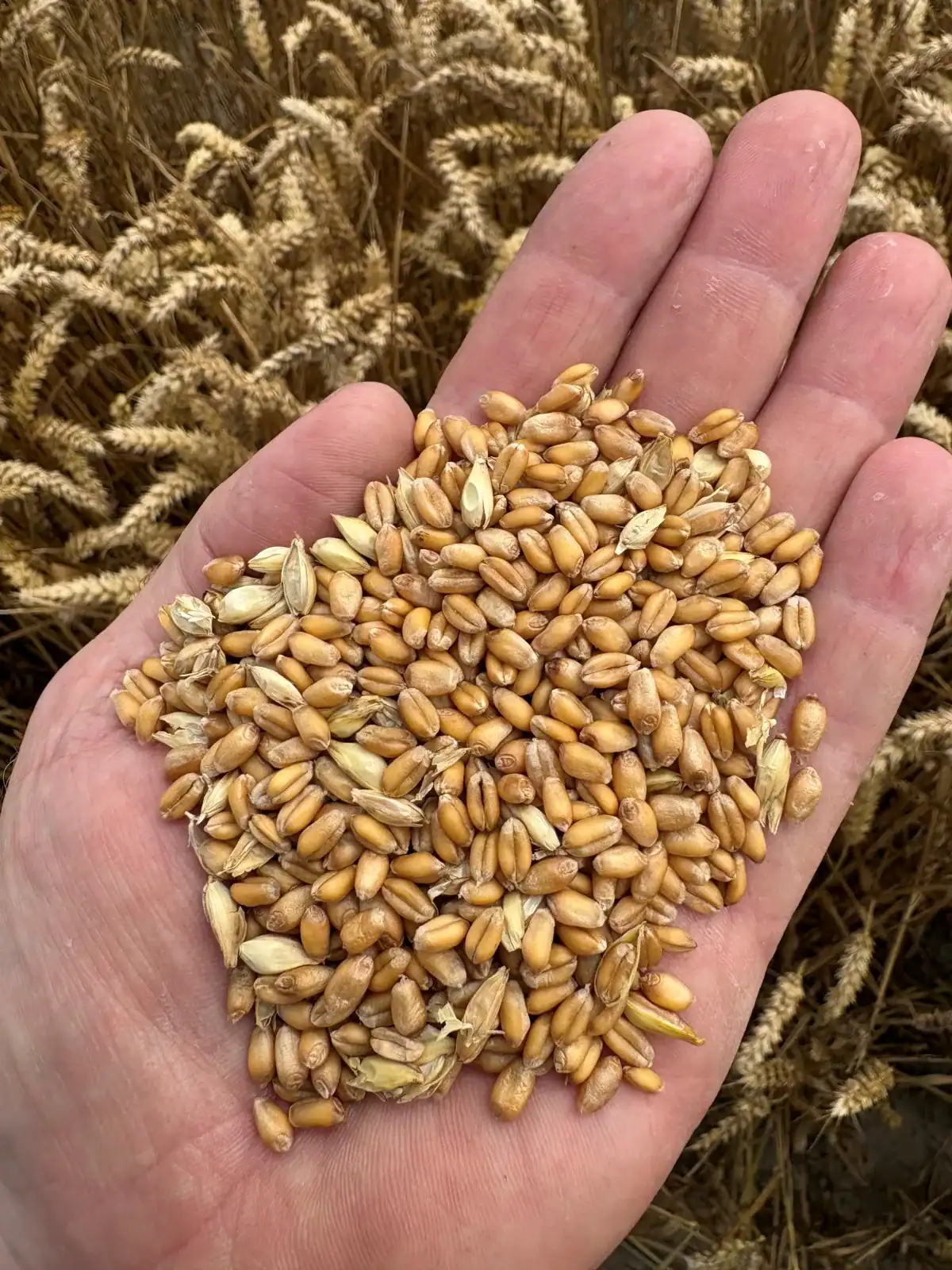
WPB Fairview wheat grain held in a hand in the field
WPB Fairview grain. Photo: John Dunne, Goldcrop.

Oats

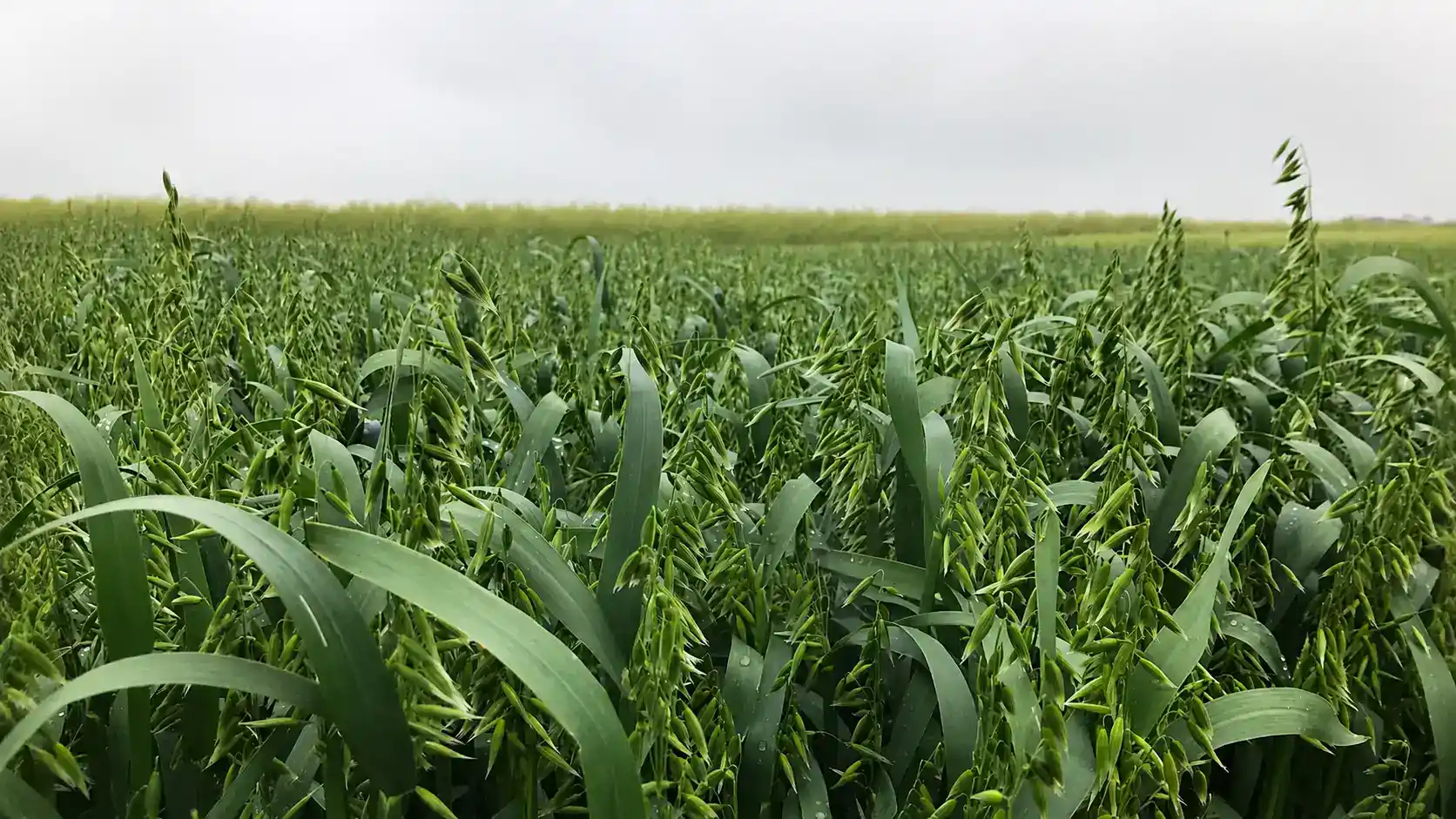
Oats


WPB Enya

WPB Enya is positioning itself as an ideal choice for both winter- and spring-sown oats.

Not only does WPB Enya have the highest KPH on the market at 57.6, it also has one of the best combinations of disease resistance, with scores of 5 for both Mildew and Crown Rust.

WPB Enya also has the largest seed size on the market, making it particularly suitable for rolling. Its larger seed size — 13% higher than its competitor — can also contribute to reduced grain losses at harvest and during subsequent processing.

Conclusion

Harvest 2026 may have challenged some of our assumptions about variety performance, but it should not change the principles behind good variety selection.

Weather will always test varieties in different ways. A dry harvest may highlight different characteristics from a wet one, but the traits that protect yield and quality in difficult conditions remain important.

For me, high KPH, good straw strength, resistance to sprouting, disease resistance and appropriate growth habit remain key considerations when selecting varieties for Irish conditions.

Because, ultimately, the right thing to do is still the right thing to do.
John Dunne Goldcrop Article by John Dunne, Goldcrop Ltd.

7 September 2026
https://goldcrop.ie/wp-content/uploads/2026/09/Winter-Cereal-Varieties.webp 941 1672 Robert Hawkes https://goldcrop.ie/wp-content/uploads/2021/07/Goldcrop-Logo-Colour.png Robert Hawkes2026-09-07 12:40:462026-09-08 09:08:03Winter Cereal Varieties: “The Right Thing to Do is Still the Right Thing to Do”

LG Armada: The Highest Yielding Winter Oilseed Rape Variety on the DAFM 2027 Recommended List

Arable Seeds, Oilseed Rape


The Department of Agriculture, Food and the Marine (DAFM) has this week published its new Recommended List for Winter Oilseed Rape, covering varieties recommended for sowing in autumn 2026. For Irish growers and agronomists planning the season ahead, the list remains the single most trusted source of independent, reliable variety information tested under Irish growing conditions.

This year the news is particularly good. We are delighted to see LG Armada join the Recommended List with the highest yield rating of any variety on it, at 106%. That places it right at the top of the table for autumn 2026 planting.

A complete package, not just a yield figure


A high yield only counts if the crop reaches the trailer. What sets LG Armada apart is how that yield potential is underpinned by a comprehensive set of genetic traits, built to protect performance and reduce risk right across the season:

  • Resistance to Turnip Yellows Virus (TuYV), a widespread aphid-borne virus that can quietly erode yield before it is ever spotted
  • Pod shatter resistance, helping to hold seed in the pod and limit losses in the run-up to and during harvest
  • High resistance and tolerance to Sclerotinia through Scleroflex, one of the most damaging diseases in oilseed rape
  • N-Flex technology, allowing the crop to better tolerate a delayed spring nitrogen application, a real advantage in a difficult Irish spring
  • Excellent lodging resistance, rated 8
  • Excellent resistance to Light Leaf Spot, rated 8, the principal disease threat to the crop in Ireland

Yield potential and peace of mind, at no premium


For growers the combination is compelling. Winter oilseed rape is a high-value break crop and LG Armada offers leading yield potential alongside a genuinely strong risk-reducing trait package. Just as importantly it does so at no additional cost compared with competing varieties on the market.

Available for autumn 2026


LG Armada will be available to Irish growers for autumn 2026 planting, alongside its exciting new stablemate LG Avenger. Between them they give growers two strong new options to consider as they plan their oilseed rape ground for the season ahead.

John Dunne Goldcrop Article by John Dunne, Goldcrop Ltd.

6 June 2026
https://goldcrop.ie/wp-content/uploads/2026/06/LG-Armada.webp 400 495 Robert Hawkes https://goldcrop.ie/wp-content/uploads/2021/07/Goldcrop-Logo-Colour.png Robert Hawkes2026-06-06 14:49:082026-06-08 09:51:52LG Armada: The Highest Yielding Winter Oilseed Rape Variety on the DAFM 2027 Recommended List

Winter Barley – “Better to be looking at it than looking for it….

Arable Seeds, Winter Barley
Winter Barley Trial Plots at Shanagarry 4th February

Winter Barley Trial Plots at Shanagarry 4th February


As we move into February, the noticeable increase in daylight hours is welcomed by all of us. The plants in the fields are also beginning to respond and are benefitting from increased sunlight, temperature and drying opportunities.

This time last year, we were looking with disappointment at many crops that were damaged from rainfall and considering which of them would need to be replanted.

In contrast, winter crops this year are for the most part in much better condition and more complete thanks to better autumn planting conditions.

Winter Barley at Shanagarry


The winter barley trial plots at the Goldcrop trial site in Shanagarry were sown on the 3rd October on land that followed spring beans. This sowing date is about 10 days earlier than our normal sowing date at this location but with memories of 2023 still etched in our minds, we took advantage of the excellent soil conditions.

Similar progress was made through much of the country where growers wanted to ensure good establishment of their crops.

The winter barley crop established and grew well thanks to the mild autumn (see Temperature Table below) and took on the appearance of quite an advanced crop. One could be forgiven for thinking that the crop had begun stem extension before Christmas but on examination, it was obviously still in the vegetative phase albeit with longer leaves than normal which gave it a taller appearance.

Monthly Mean Air Temperature – Degrees C (source: Met Eireann, Roches Point, Cork)

SeptemberOctoberNovemberDecember January
2024/2514.112.410.38.66.6
2023/2415.212.29.48.96.1
Long Term Average13.911.48.97.46.8

Earlier varieties – earlier intervention


The advent of BYDV tolerant winter barley has been a great development for the crop, it allows growers to plant a little earlier while safe in the knowledge that the potential damage from BYDV is greatly lessened. Earlier planting has the benefit of getting through more planting when soil conditions are good; this lends itself to better establishment and is kinder to the soil.

The first BYDV tolerant varieties have been 6 row types, bred in France (for example Integral). These 6 row types are quicker developing and earlier to ripen than the 2 row British types that we have been used to.

The earlier development of these types leads to an earlier demand for the application of fertiliser in the spring and subsequent PGR when weather is suitable. Failing to apply nitrogen on time can result in loss of tillers and reduced yield.

At our southerly location, we commonly begin our first applications of Nitrogen to winter barley in the second half of February. This date can be 7-10 days later further north as spring growth doesn’t start as early.

It is not uncommon for a few weeks of dry weather to occur in early spring so getting the fertiliser applied that bit earlier should ensure that it is washed in should a dry spell occur.

This year, given the extra level of growth in many winter barley crops, it is likely that any residual nitrogen in the soil has already been utilised by the crop and timely application of nitrogen will be important to sustain the extra biomass that has been created in crops. The winter barley at the Goldcrop trial site received its first round of fertiliser on the 8th February this year. I would be happy to do it a week later, but I wanted to make use of the calm day and suitable ground conditions. This first split consisted of 370kg/Ha of 10.10.20 (30 units of N/acre). I aim to have all Nitrogen applied to the crop by GS30 (approx. mid March).

PGR will be applied during growthier conditions, this will be applied at approx. GS30-31 with the aim of evening out tiller size and shortening the early stem development.

[ Left to right ] 6 row versus 2 row – Growth habit comparison & Integral in vegetative phase – 4th February

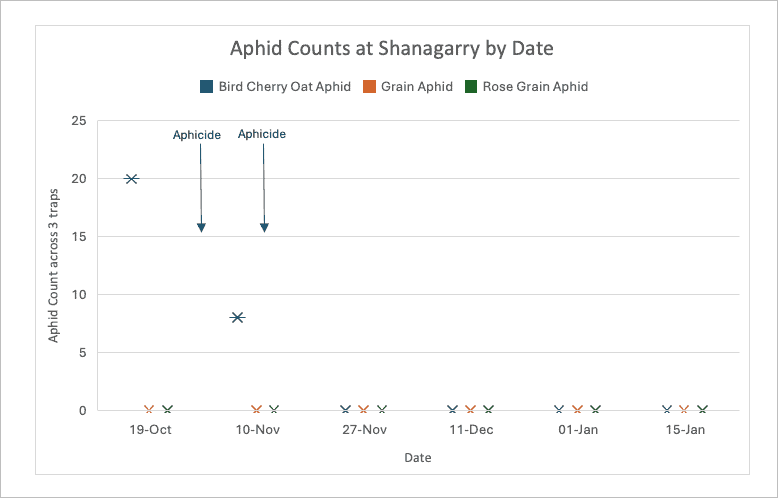
Aphid Numbers


As part of the nationwide Teagasc Aphid Count Survery, We host aphid traps at the Goldcrop trial site. These traps are emptied every two weeks following crop emergence.

3 traps are placed in the crop at varying distances (10, 20 & 50m) from a hedge. The contents of each trap are analysed every two weeks and any aphids present are counted and identified.

Two aphicides were applied to the crop at Shanagarry; while the surrounding crop is the BYDV tolerant variety Integral, the trials themselves contain many varieties which are not BYDV tolerant, and it is essential that these varieties are protected in such a mild autumn.

Interestingly, the aphid counts reflect the impact of the aphicide application on aphid numbers. Aphid counts remained at zero following the second aphicide application, this indicates that no further aphid flight into the crop took place after mid November.

The counts are shown in the following table

Aphid Numbers


Aphid Traps & Application of fertiliser to Goldcrop trial plots – 8th February


John Dunne Goldcrop Article by John Dunne, Goldcrop Ltd.

13 February 2025
https://goldcrop.ie/wp-content/uploads/2025/02/Winter-Barley-Trial-Plots-at-Shanagarry.webp 400 495 Robert Hawkes https://goldcrop.ie/wp-content/uploads/2021/07/Goldcrop-Logo-Colour.png Robert Hawkes2025-02-13 07:14:312025-02-11 12:30:46Winter Barley – “Better to be looking at it than looking for it….

Winter Oilseed Rape – Sticking With The Plan!

Arable Seeds, Winter Oilseed Rape

Winter Oilseed Rape

As a farmer, I am quite a fan of rotation. However, we were not always using rotation on our farm and up until 2007, our rotation (or lack of!) consisted of continuous spring barley. While the spring barley cropping was relatively simple, it did bring workload bottlenecks and yields that were only average.

In 2007, we grew our first two fields of WOSR and in all honesty, we haven’t looked back.

WOSR has become a critical part of our rotation, and it has brought increased cereal yields, a spread to our workload and a great way to keep on top of grass weeds.

Our current rotation generally consists of two consecutive cereal crops followed by a break crop (WOSR or beans every second time).

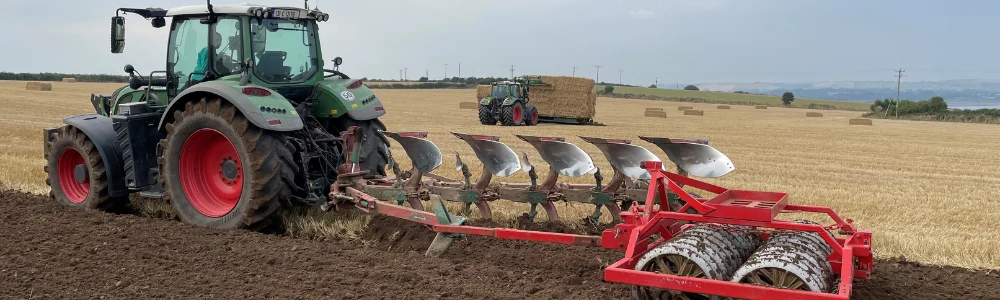
Autumn 2023 / Spring 2024 as we know, was a difficult harvest year to establish crops. We are now preparing to sow our WOSR crop for harvest 2025. This year, our entry crop is a crop of spring barley sown on the 22nd April and harvested a week ago. That barley crop yielded very well and the straw has been cleared. We are in the process of ploughing it so that we can sow WOSR (LG Armada) before my absolute cut-off date of the 20th September.

September might to some sound “late” for sowing WOSR. However, given our southerly latitude and the fact that the soil is currently in superb condition, I have no concerns about the sowing date. In fact, over the past 16 years, I can only remember sowing our WOSR in August on one occasion!

Over that time, our WOSR yields have averaged approximately 5tn/Ha (2tn/Ac). A large part of this consistently good yield performance is due to the genetic improvements in the WOSR varieties being grown. Increased seed yield and useful traits such as resistance to Pod Shatter & TuYV, N-Flex, Sclero-Flex etc have all made WOSR too attractive for me to ignore.

Winter Oilseed Rape Sowing

The reasons that I am not concerned about this sowing date are as follows:

  • Our historic yields from September sown WOSR have been very good.
  • Modern varieties are almost exclusively hybrids which possess vigour for quick establishment.
  • Following the low rainfall summer of 2024, the soil is in fabulous condition and this should lead to good seed beds and an excellent start for the crop.

Other considerations that are on my mind are that I want to maintain our rotational plan and also the fact that sowings of WOSR in the UK and other European countries are likely to be heavily reduced this autumn due to the problem of Cabbage Stem Flea Beetle. Thankfully, I have not experienced a problem with this pest while growing WOSR. If sowings in the large countries are reduced, this should only have a positive effect on prices next harvest.

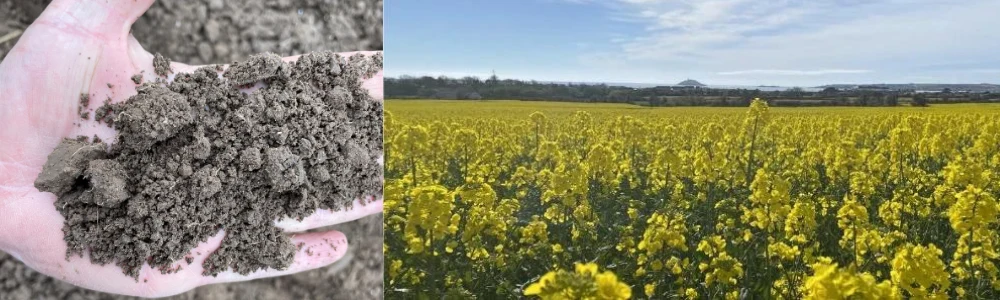
In order to maximise establishment, I concentrate on creating a fine seed bed. WOSR is a small seed and good seed/soil contact is critical. NPK fertiliser will be incorporated in the seed bed to give the seedlings immediate access to nutrients. A reduced rate of slug pellets will be applied after rolling as a matter of course.

The seed rate used will be approximately 50 seeds/m2. We sometimes use strip tillage for planting WOSR and in those cases, I increase the seed rate to allow for the lower establishment rate that is commonly experienced with strip tillage.

John Dunne Goldcrop Article by John Dunne, Goldcrop Ltd.

10 September 2024
https://goldcrop.ie/wp-content/uploads/2024/09/Winter-Oilseed-Rape-–-Sticking-With-The-Plan.webp 400 495 Robert Hawkes https://goldcrop.ie/wp-content/uploads/2021/07/Goldcrop-Logo-Colour.png Robert Hawkes2024-09-10 13:30:132024-09-10 13:44:52Winter Oilseed Rape – Sticking With The Plan!

Slug damage in Winter Hybrid Rye – Not all varieties are Equal!

Top Tips, Arable Seeds


Winter Hybrid Rye has demonstrated itself as a high yielding crop that can fit in a rotation as either a first cereal after a break crop or following a cereal crop where it’s strong resistance to the Take-All fungus can allow it to produce a high yield where a winter barley crop or winter wheat crop may struggle due to their lower resistance to Take-All.

One of the main challenges when growing Hybrid Winter Rye is around establishment; it has shown itself to be very palatable to slugs in the early stages of growth, much more so than the other cereal crops.

The challenge in establishing Hybrid Rye where slugs are present is compounded by the fact that the crop is sown using a low seed rate (200 – 250 seeds/m2) leaving very little room for error due to in field losses.

For the second year running, it has been noticed in trial plots that some varieties of Hybrid Rye are less susceptible to slug damage. The exact reason for this difference amongst varieties is unknown but it is assumed that it is down to differences in palatability for slugs.

In Goldcrop trials, two varieties in particular have stood out as being less susceptible to slug damage: namely SU Performer and the new and upcoming variety SU Karlsson.

The knowledge that these varieties are less susceptible to slugs will be very useful for growers and agronomists alike as it should provide us with one more tool to lessen the risk of slug damage when establishing Hybrid Rye.

It is important to remember that no variety of Hybrid Rye is completely resistant to slug damage and damage can be expected if the slug burden is high enough in a given field.

Article by John Dunne, Goldcrop Ltd.

27 February 2024
https://goldcrop.ie/wp-content/uploads/2024/02/Winter-Hybrid-Rye-Information.png 400 495 Robert Hawkes https://goldcrop.ie/wp-content/uploads/2021/07/Goldcrop-Logo-Colour.png Robert Hawkes2024-02-27 17:45:312024-03-07 18:10:34Slug damage in Winter Hybrid Rye – Not all varieties are Equal!

KWS Dawsum | Everything I want in a Wheat Variety

Arable Seeds, Winter Wheat

KWS Dawsum Winter Wheat

The harvest of 2023 will be one that many people will want to put behind them, weather made it a battle to plant crops and a battle to harvest them. We must be thankful that 2022 was exceptionally good, and we hope that this will be a help from both a financial and morale point of view.

Along with my role within Goldcrop, I farm a 230ac mixed tillage rotation consisting mainly of broad leaf break crops, winter wheat and some spring barley. Our system of farming has evolved to one that uses the break crops to create as much first cereal land as possible. This first cereal land is almost exclusively planted with winter wheat. Why winter wheat? Over the years, I have found winter wheat to be consistently the best-performing crop financially – it has the potential to produce a high yield and the ability to deal with difficult conditions (heavier textured soils, wet winters etc).

Looking forward, I think that if we are indeed entering into an era of more fluctuation in terms of weather and grain prices, then winter wheat may well be an even more important crop in Ireland due to its ability to survive wet winters and take advantage of high grain prices when they do occur.

Harvesting KWS Dawsum 2023

Dawsum has been Awesome for us…

With 20 years spent in variety testing at Goldcrop, I have seen many wheat varieties come and go. In my inexperienced early years, my head was easily turned by the soft, impressive-looking wheats that promised massive yields, but I quickly learnt just how disappointing such varieties can be in a wet harvest where problems such as sprouting, Fusarium, lodging, and even shedding quickly rob that yield potential. As they say: “good looks don’t boil the pot”…..

When KWS Dawsum came along, I quickly moved to it as it had the traits that I see as valuable in a wheat variety:

  • High & Reliable Yield Potential
  • High KPH grain with excellent resistance to sprouting & shedding
  • Good straw strength
  • Suitable as a second wheat

In 2022, we grew 89 acres of KWS Dawsum (45% first crop, 55% second crop), the average yield was exactly 5tn/ac (adjusted to 20%mc). 2022 as we know was a dream year where our fields had no blank patches and with the exception of BYDV, our wheat crops had a smooth run.

For 2023, we grew 61 acres of KWS Dawsum (all first crop). The year was the polar opposite to 2022 in terms of getting crops established. One poorly drained 9ac field was sown in October, and the balance of the wheat was sown in the first week of December. Despite all the challenges thrown at the wheat, our average yield of Dawsum came in at 4.5tn/ac (adjusted to 20%mc).

KWS Dawsum Sown December 2023

Growing KWS Dawsum

From an agronomic point of view, I have become quite familiar with growing KWS Dawsum. Whilst it is taller than its predecessor Costello, it has good resistance to lodging (7/9) and lodging prevention hasn’t been complicated. My normal approach is a mix of CCC & Moddus at GS30. In most years, I follow this with a later application of Medax Max as I find this gives good shortening without being too hard on the crop.

In terms of disease control, we farm in Cork, so Septoria control is going to be a top priority – sowing date, full rates of fungicide, and accurate application timing are our main tools.

Dawsum has superb resistance to both Mildew (8/9) and Yellow Rust (8/9) so thankfully, I don’t need to give much thought to these diseases when growing Dawsum. Yellow Rust in particular, has become more common in Ireland in recent years, and I always find it comforting to know that when I leave the field with the sprayer I won’t have to come back just to target Yellow Rust.

So, to sum up – KWS Dawsum provides us with what we want – a winter wheat variety that can deliver high yields with minimum risk.

For harvest 2024, we have 84ac after-break crops to be planted with winter wheat. It will be planted to one variety. Which variety? I’ll let you guess………

Article by John Dunne, Goldcrop Ltd.

4 September 2023
https://goldcrop.ie/wp-content/uploads/2023/09/KWS-Dawsum-Post.webp 400 495 Robert Hawkes https://goldcrop.ie/wp-content/uploads/2021/07/Goldcrop-Logo-Colour.png Robert Hawkes2023-09-04 11:56:012023-09-04 12:26:24KWS Dawsum | Everything I want in a Wheat Variety

My Farming Year by John Dunne

Arable Seeds, Top Tips


Savour the Golden Year

No two years are the same as they say and looking back at 2022 as tillage farmers, we can certainly say that it was a golden year. The “holy grail” of weather, yields and harvest prices combined to deliver some of the highest profit margins that have ever been seen on Irish tillage farms. Growers received a very just reward for their toil and risk taking and it acts as a great motivation to push on in subsequent years. It is true to say that such a good year can be further appreciated if you have experienced the tough years like 2009, 2012 etc.

On the flip side, we must remember that many a good party is followed by a painful hangover and getting through that can be challenging. The hangover has come in the form of greatly reduced grain prices and high input costs. Throw in difficult autumn and spring planting weather and it can quickly focus the mind to doing what we can to achieve an actual margin.

De-Risk and using the Tools that are Provided.

I will admit that I am a worrier by nature, the “worry gene” came from my mother and I can see it in one of my daughters now too! I have successfully dealt with this trait over the years by risk measuring and planning to remove risk as much as is practical. Farming by its very nature is a risky career, the vagaries of weather and markets can quickly conspire against us, however – we must accept some risk to make a margin and to progress the farm business.

My approach to tillage farming is to have a relatively simple farm consisting of a rotation that optimises yield performance of each crop to deliver a reliable and hopefully high profit margin for the time invested. I will look after the land and give crops what I think they need to achieve their potential. Over the years, this system has delivered for us. The following points are some of the tools that I see as being important to de-risk a tillage farming system.

Rotation & Crop Choice

Our farm has evolved from a continuous spring barley system to one which maximises winter wheat and broad leaf break crops such as WOSR and beans. As discussed in last years open day book, I like wheat for its ability to deal with tough conditions and its ability to deliver margin.

The profit potential of wheat was evidenced in 2022 where its high output was able to take advantage of the high prices on offer. As detailed on the margins section of this book, winter wheat still has the potential to give a good profit margin relative to other cereals even in this year of lower grain prices and high costs. The broad leaf break crops have many benefits, they benefit the following cereal and are useful for spreading workload. They move the goal posts for grass weeds and can be quite profitable in their own right. Beans in particular are an attractive crop in 2023 due to the protein payment and some strong forward selling opportunities.

Cultivation Systems & Crop Establishment

Preparing the soil for the planting of the crop is one of the most important days in the life of a crop and we only get one chance per year. As a wise young Ag Science student (Joe Millerick, 2013) once said to me: “a seedbed is probably called that for a reason”, the seed bed should be a comfortable place for the seed and free from threats.

No particular method of crop establishment should be dismissed out of hand and while I am a firm fan of the plough, we frequently use strip tillage for some crops. The plough’s ability to dry land when needed, undo compaction and mechanically reduce some pest, disease and weed threats makes it more relevant to IPM in the Irish climate than some would give it credit for.

Choosing the right genetics and harness the potential.

The Irish climate has the potential to produce some of the highest crop yields in the world. I am a firm believer that we should aim to harness this potential. Not only are higher yields closely tied to higher crop profit margins, but higher yields also make the most efficient use of productive land and inputs. Some commentators would prefer to pull us back into the romanticised past in terms of agricultural production, but they would be well advised to consider that food will need to be produced somewhere, if not on a productive Irish field, then on a former rainforest somewhere. Look at the numbers, not the story book pictures……

Choosing the right varieties to harness the potential of your farm is a vital foundation for the success of each harvest. As someone who is involved in the development of new varieties, I am fortunate to have the opportunity to see new varieties at an early stage and to meet breeders to discuss their latest developments.

The work that these breeders are doing is the life blood of our tillage farming businesses. Not only do we need increased yields, but pests and diseases adapt, and we need new varieties to stay a step ahead. The level of investment by these breeding companies runs into millions of euros each year and is quite impressive when you see it. Talented people, glasshouses, and computer predictive breeding, not to mention the potential use of Gene Editing.

Recent examples of these new genetic traits are MLO mildew resistance in barley, BYDV tolerance in winter barley, BYDV resistance in winter wheat and Turnip Yellows Virus Resistance in WOSR. Not only do these traits increase yield, but they also remove risk from the farming system.

Onwards and Upwards

I am very optimistic about the future of tillage farming in Ireland. Perhaps this is the enthusiasm of youth, but I think not (I’m closer to 50 than 40 now). We are surrounded by a tillage industry that is passionate about what they do. Such passion is impossible to measure and does not fit on an economists’ spreadsheet, but it is this passion that drives us forward to be best at what we do. We can all strive to become the best by paying attention to good advice and following the science.
Someone must be the best, why can’t it be you?

Article by John Dunne, Goldcrop Ltd.

1 September 2023
https://goldcrop.ie/wp-content/uploads/2023/09/John-Dunne.webp 400 495 Robert Hawkes https://goldcrop.ie/wp-content/uploads/2021/07/Goldcrop-Logo-Colour.png Robert Hawkes2023-09-01 17:57:522023-09-01 17:57:52My Farming Year by John Dunne

Winter Oilseed Rape (WOSR) Experiences on the Dunne Farm East Cork

Arable Seeds, Winter Oilseed Rape
LG Auckland April 2nd 2023

LG Auckland April 2nd 2023

I farm in East Cork with my brother Alan, and since moving away from a spring barley monoculture in 2007, we have become firm believers in rotation. This rotation includes Winter Oilseed Rape, Beans, Winter Wheat, Winter Barley and Spring Barley.
The reasons we use rotation can be summarised as follows:

  • Break crops in the rotation lead to higher cereal yields.
  • Rotation spreads the workload and weather-related risk.
  • Break Crops provide an opportunity to control grass weeds.
  • Rotation improves soil health through N fixation (legumes) and the incorporation of crop haulm.

Winter Oilseed Rape has had a place in our rotation ever since we first grew it in 2007. We immediately saw a lift in our spring barley yields and now have moved to grow more winter wheat to capture the yield benefit of the preceding break crop fully.

We try to grow WOSR every 6th year, using cereals and beans in the intervening years. I am a firm believer in the phrase,

“The less often you grow any crop, the better it will perform”.

Over these 17 years, we have learnt a lot about growing the WOSR crop and have seen great improvements in the genetics available in the varieties; more on this later.

Planting LG Auckland 1 Sept 22

Planting LG Auckland 1 Sept 22

The 2023 Crop

This year’s crop (LG Auckland) was sown on Sept 1st, following spring barley. The land in question had grown an excellent crop of spring barley in 2022 (4tn/ac), and it would have been tempting to go with spring barley again for 2023, but I wanted to stick with the planned rotation and something in my gut reminded me that it might be good to not be completely exposed to August as our sole harvest month in 2023. For the same reason, we planted a couple of fields of Winter Barley (not a crop that we commonly grow); little did I know how this would transpire…..

LG Auckland established Sept 29th 2022

LG Auckland established Sept 29th 2022

Establishment

The LG Auckland was planted using strip tillage (Sumo DTS planter); the stubble had received a run of a disc harrow prior to planting to increase the level of tilth on the surface and to lessen any slug pressure. I like strip tillage for WOSR as the leading shank of the planter creates a compaction-free channel under the seedling which allows the root to grow vertically unimpeded by compaction. In addition, the strip tillage loses less soil moisture which was important in the summer of 2022.

The target plant population was 40 plants/m2. 52 seeds/m2 were planted, assuming an establishment rate of approx. 75%. In a plough-based system, the establishment rate would be expected to be higher through better seed placement when compared to strip tillage.
The crop’s P&K requirements, along with a small amount of N was applied at planting.

The crop was established well, and weed control consisted of an early application of a graminicide followed by a post-emergence application of Legion.
No fungicide was applied in the autumn as the land became untrafficable.

LG Auckland Oct 20th 2022 (2)

LG Auckland Oct 20th 2022 (2)

The Growing Season

Thankfully, disease levels (Light Leaf Spot and Phoma) appeared to be negligible in the spring (LG Auckland has very good disease ratings). Our climate can lend itself to high levels of Light Leaf Spot, which can be very difficult to control chemically if it becomes established. A fungicide (0.6L/Ha Proline) was applied at stem extension along with Epso Bortop (Mg, S & Boron). A second fungicide (0.8L/Ha Prosaro) was applied at mid-flowering with a second application of Epso Bortop. Caryx was also applied at early stem extension as a PGR.

The Nitrogen input for the crop was curtailed as it had, for the most part, developed a high Green Area Index by spring. However, I had another reason to cut back on N: Parts of the field had sat very wet over winter and into the spring, so much so that I felt that the rooting in these areas was heavily compromised. With concerns over the rooting in these areas and consequent lodging in my mind, I applied a total of 120 units/ac (150kg/Ha) of N to the crop; 30 units of this were left until just before the crop was too tall to spread fertiliser (late N can benefit the yield of WOSR by increasing seed size).

Harvesting LG Auckland 25th July 2023

Harvesting LG Auckland 25th July 2023

The crop of LG Auckland was harvested on the 25th of July. The yield of the crop came in at 2.1tn/ac (5.2tn/Ha) in a moisture range of 9-10% and it was sold to Dairygold. I was delighted with the yield considering how waterlogged some of the fields had been over winter and also considering the relatively low nitrogen input. A crop of KWS Dawsum winter wheat is the next crop planned for this land.

Improved Genetics

Since we first started growing WOSR, we have seen great advances in the yield potential and specific traits available in the modern WOSR varieties. Pod Shatter is something that, for us as growers, is non-negotiable; I will not grow a variety without it, and Goldcrop will only sell varieties that have this trait. (varieties with Pod Shatter Resistance include DK Expansion, DK Expose, LG Ambassador, LG Auckland and LG Armada).

Because of our mild climate, TuYV (Turnip Yellows Virus) is a common disease of WOSR in Ireland, varieties are available from Goldcrop with TuYV resistance, and this trait brings an extra level of consistent performance to WOSR in Ireland (varieties with TuYV resistance include LG Auckland, LG Ambassador, LG Armada and DK Expose).


Goldcrop Winter Oilseed Rape (WOSR) Seed Variety List 2023


Click for PDF Download


Article by John Dunne, Goldcrop Ltd.

3 August 2023
https://goldcrop.ie/wp-content/uploads/2023/08/LG-Auckland.webp 400 495 Robert Hawkes https://goldcrop.ie/wp-content/uploads/2021/07/Goldcrop-Logo-Colour.png Robert Hawkes2023-08-03 17:41:342023-08-04 09:57:39Winter Oilseed Rape (WOSR) Experiences on the Dunne Farm East Cork

Stubble Cultivation for Slug Control Following Winter Oilseed Rape

Arable Seeds, Top Tips, Winter Oilseed Rape

Top Tips


✔︎ Stubble cultivation should be immediately after harvest before slugs move deeper.

✔︎ Cultivation should be carried out in good drying conditions to maximise desiccation of slugs and their eggs.

✔︎ Don’t cultivate too deeply, 2 inches is ideal. You do not want to bury the slugs and their eggs.

✔︎ A loose, unfirmed surface is ideal to ensure good drying out of the soil.

✔︎ Repeat 3 weeks later for best effect.

✔︎ Always check for slugs and eggs prior to planting a cereal after WOSR.


Article by John Dunne, Goldcrop Ltd.

2 August 2023
https://goldcrop.ie/wp-content/uploads/2023/08/Stubble-Cultivation-495-×-400px.webp 400 495 Robert Hawkes https://goldcrop.ie/wp-content/uploads/2021/07/Goldcrop-Logo-Colour.png Robert Hawkes2023-08-02 18:14:512023-08-04 10:39:07Stubble Cultivation for Slug Control Following Winter Oilseed Rape

Oilseed Rape | Thriving in Ireland

Arable Seeds, Oilseed Rape

This Blog Post was taken from the latest issue of Crop Protection Magazine, where Goldcrop’s John Dunne was interviewed. Read the article in full here.


OSR hasn’t always been the break crop of choice in Ireland, but it’s gained popularity as a replacement for sugar beet since 2006, says John Dunne farmer and variety manager for seed-supplier, Goldcrop.

“Growers quickly realised how good a break crop it is and subsequently the OSR acreage has increased and is expected to be 19,000ha this year,” he explains.

One reason for the increasing area has been better yields, says John. “We’ve seen a 30% increase over the past six years. Whereas growers would previously have achieved 4-4.5t/ha, they’re now regularly getting 5-5.5t/ha – so it’s a big increase.”

But getting the crop sown in time can be a challenge, he says. “Planting OSR behind winter barley is fine, but trying to get it in after winter wheat or spring barley can be tricky. In 2006, growers started out with conventional varieties but they’ve moved towards hybrids over time. We have to be careful that varieties aren’t too vigorous, but we’d rather be looking at the crop than looking for it.”

Having traits such as TuYV resistance in varieties is really important to Irish farmers because the climate is quite mild and the disease can take up to a third of OSR yield, according to John. “When we get a frost, it’s a notable topic of conversation here. And because it’s so mild, we’ve had issues with barley yellow dwarf virus, and this made me wonder if TuYV was also nipping at OSR yields.”

Working with Limagrain, Goldcrop took samples of varieties without TuYV resistance and found the virus to be consistently showing up. “Once you get your eye in for identifying the virus symptoms, you’ll see a reddening of leaves at the edges of the field and along tramlines. Last year we saw headline varieties without resistance falter in our official trials, whereas resistant varieties took this risk out of the equation.”

According to John, Irish growers have also had more trouble with LLS than with phoma and so really value highly resistant varieties. “LLS has always been the tougher beast, to my mind, and in some years the circumstances play into it with higher pressures, especially when there are nearby OSR stubbles. As the disease cycles so frequently and repeatedly, it can be hard to control and is the most damaging disease we have, so having genetic resistance is a huge help.”

He also feels that pod shatter resistance has to be standard in all varieties. “Our climate is tricky, so to have something that won’t shed is a big safety net. I can’t really believe that varieties still come to market without it.”

Irish farmers have become very fond of growing OSR, adds John. “It’s an essential part of the rotation for many, so having stacked traits to secure its future place here is important.”

Article by John Dunne, Goldcrop Ltd. 
31 May 2023
https://goldcrop.ie/wp-content/uploads/2023/05/Oilseed-Rape.webp 750 750 Robert Hawkes https://goldcrop.ie/wp-content/uploads/2021/07/Goldcrop-Logo-Colour.png Robert Hawkes2023-05-31 15:54:592023-05-31 17:19:43Oilseed Rape | Thriving in Ireland
Page 1 of 212
Search Search

Sign Up Croptalk Newsletter

Categories

  • Arable Seeds
  • Beet
  • Brassica Crops
  • Certified Seed
  • Fodder Rape
  • Forage Seed
  • Grassland
  • Maize
  • Oilseed Rape
  • Pasture Profit Index
  • Press Release
  • Red Clover
  • Research
  • Reseeding
  • Spring Barley
  • Spring Oilseed Rape
  • Top Tips
  • White Clover
  • Winter Barley
  • Winter Beans
  • Winter Oilseed Rape
  • Winter Wheat

Product Ranges

  • Arable
  • Forage
  • Crop Protection
  • Goldcrop Amenity
  • Goldcrop Horticulture
  • Fencing
  • Lawn Seed

Locations

Springhill, Carrigtwohill, Co. Cork T45 F685 Ireland

Killavullen, Mallow, Co. Cork P51 CK38 Ireland

Cluide, Dunleer, Co. Louth A92 DK88 Ireland


Product Range

  • Arable
  • Forage
  • Crop Protection
  • Goldcrop Amenity
  • Goldcrop Horticulture
  • Fencing
  • Lawn Seed

Quick Links

  • Agri Sales Team
  • Contact Us
  • Croptalk Blog
  • Our Story
  • Careers
  • Goldcrop Catalogues
  • Book a Speaker
  • Pasture Innovations
  • Accessibility statement
  • Goldcrop Partners Media Portal

Connect

  • Twitter
  • Facebook
  • LinkedIn
  • YouTube
© Copyright - Goldcrop | website & marketing by Method Marketing
  • Link to X Link to X Link to X
  • Link to Facebook Link to Facebook Link to Facebook
  • Link to LinkedIn Link to LinkedIn Link to LinkedIn
  • Link to Youtube Link to Youtube Link to Youtube
Scroll to top Scroll to top Scroll to top