
Spring Oilseed Rape | What a Performer | Case Study by John Dunne

The spring of 2023, following a somewhat premature start, has turned out to be slow in getting going.
A record-breaking wet March gave way to a thus far mixed month of April with land remaining wetter than we would like and progress with the sowing of spring cereals quite a bit behind target.
We know that a well-established crop of spring barley, even when sown later than preferred, still has the potential to yield very well if it hits the ground running and has everything in its favour.
Spring Oilseed Rape (SOSR) could provide a very useful way of avoiding the challenge of sowing late-spring barley while at the same time introducing a break crop to land that may be in need of rotation.

Excerpt from the AHDB Spring OSR Descriptive List 2023 | Click To Download PDF
Economically, based on current costings and grain prices (Teagasc crop costings 2023, green barley price of €215/tn, OSR price of €425/tn), a good crop of SOSR should at least match a good crop of late sown spring barley with the added benefits of rotation and spreading workload.
The yield potential of SOSR has increased greatly with the advent of newer hybrid varieties. These varieties have the vigour to establish quickly and to create a big canopy of pods in a short growing season.
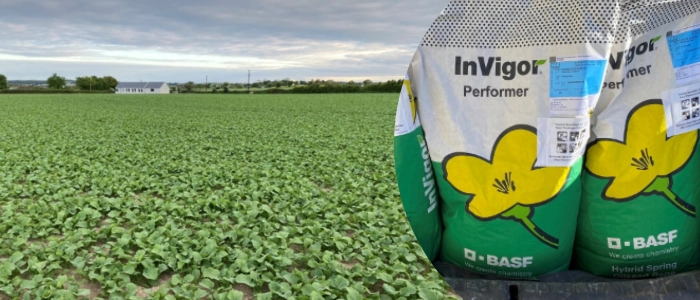
One such variety is PERFORMER, bred by BASF in Germany. First listed on the SOSR Recommended List (UK) in 2020, Performer has not yet been surpassed for its yield potential.
For the above reasons, I chose to grow two fields of PERFORMER SOSR on our own farm in 2022.
The background to my decision to grow Performer was 2-fold; firstly, the fields in question are slow to dry out in spring due to their heavy clay subsoil, and secondly, both fields had been growing spring barley with a number of years, and I was conscious that they would benefit from a break crop.
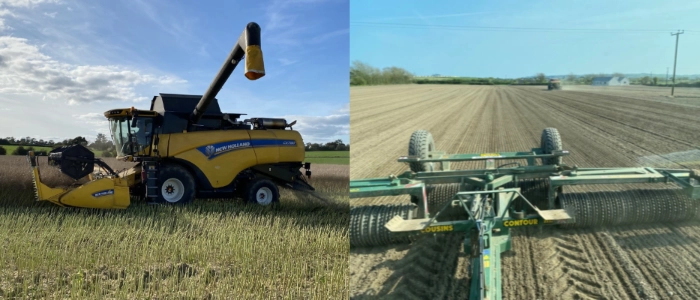
The crop was sown on the 28th of April using a plough and one-pass system. The sowing rate used was 80 seeds/m2 (1 pack to 2.6 Ha) to achieve 70 plants/m2.
NPK was mixed through the seedbed, and the seedbed was rolled immediately to encourage quick and even germination. Butisan S was applied as weed control immediately after rolling. An application of CAN+S was applied once tramlines were visible, bringing the total N used to 150kg/Ha.
The crop grew really quickly, with the vigour of the variety being quite apparent. The crop was monitored for flea beetle, but no control was required.
I desiccated the crop on the 1st of September with Glyphosate. Harvest was delayed due to broken weather. However, we harvested the crop in excellent conditions on the 21st of September, only 19 weeks after it was sown. The crop yielded a very pleasing 4.1T/Ha at 12-12.5% mc. The crop also qualified for the SIM Straw incorporation measure.
Once the crop was harvested, we gave the SOSR stubble one shallow run of a disc harrow to incorporate the chopped straw and also to lessen the risk of any slug survival following the crop.
Overall, PERFORMER spring OSR delivered a high-yielding and profitable crop for me in 2022 and provided an ideal entry crop for the first cereal in good time for autumn sowing. It must be considered as a viable rotational crop-option on farms, especially if a late spring season prevents alternative break crops like winter OSR, beans or oats from being sown.”
 Article by John Dunne, Goldcrop Ltd.
 Goldcrop