Skip to content
  • Link to X Link to X Link to X
  • Link to Facebook Link to Facebook Link to Facebook
  • Link to LinkedIn Link to LinkedIn Link to LinkedIn
  • Link to Youtube Link to Youtube Link to Youtube
  • CROPTALK BLOG
  • Shopping Cart Shopping Cart
    0Shopping Cart
Goldcrop
  • Forage Seed
    • Grass Seed
      • Grass Seed Mixtures
      • White Clover
      • Red Clover
    • Maize & Beet
      • Maize
      • Beet
    • Brassica Fodder Crops
      • Fodder Rape Crop
      • Kale Crop
      • Swedes Crop
      • Stubble Turnips Crop
    • Breeding
      • Teagasc Forage Breeding Program
  • Arable Seeds
    • Cereals
      • Cereal Varieties Recommended Lists
      • Barley
      • Oats
      • Wheat
      • Triticale
      • Hybrid Rye
    • Catch Crops
      • Catch Crop Mixtures
    • Oilseed Rape
      • Winter Oilseed Rape
    • Pulses
      • Spring Beans
      • Winter Beans
      • Peas
  • Crop Protection
    • Adjuvant Range
    • Herbicide
    • Fungicide
    • Trace Element Range
    • Plant Growth Regulator
    • Insecticide
    • Slug Pellets
  • Amenity
  • Other Categories
    • Goldcrop Horticulture
    • Bird Food
    • Fencing
    • Lawn Seed
  • Resources
    • Croptalk Blog
    • Book a Speaker
    • Careers
    • Our Story
    • Goldcrop Catalogues
    • Contact Us
    • Agri Sales Team
    • Research and Development
      • Teagasc Forage Breeding Program
    • Goldcrop Partners Media Portal
  • Click to open the search input field Click to open the search input field Search
  • Menu Menu

Multi-Species Sward and Red Clover Silage Measures 2023

Forage Seed, Certified Seed, Red Clover

The Department of Agriculture, Food & the Marine have announced the opening of the 2023 Multi-Species Sward and Red Clover Silage measures as part the Government’s commitment to facilitating Irish farmers further improve the sustainability of Irish agriculture. Funding for these measures has been increased to €2.5m to allow for greater support in establishing these swards.

Key changes to measures from last year’s pilot scheme.

⒈Payments will be made directly to the approved farmer on a per hectare basis.

⒉The payment rate has been increased to a potential €300/Ha, this will reduce if applications exceed the available combined budget for both measures.

⒊To receive payment under either measure an applicant must indicate the correct crop type on their 2023 BISS application.

Some of the key points on how these programmes operate.

✔︎ The application portal will close on the 29th May, 2023

✔︎ To be eligible under these Measures, the swards must be sown by 15th July and established by 30th September 2023

✔︎ At the claim stage, applicants must indicate the area sown as multi-species/red clover and upload their supporting documentation online i.e. invoices and seed labels.

✔︎ In order to receive payment under the Red Clover Silage Measure for the parcel(s) where they are sowing the red clover silage mixture, an applicant must indicate the crop type as Red Clover on their 2023 BISS application,

✔︎ Under the Measures, swards are not permitted to be sown on Commonage land, Natura 2000 sites, NHA designated land, Environmentally Sensitive Permanent Grassland or within archaeological monument buffer zones.

✔︎ Only seed purchased after the application is lodged on Agfood.ie and before the final date for sowing the crop, 15th July 2023, is eligible under these Measures.

Prospective applicants should read the Terms and Conditions published at

gov.ie – 2023 Multi Species Sward Measure (www.gov.ie)

gov.ie – Red Clover Silage Measure (www.gov.ie)

Goldcrop have two mixtures that meet the criteria ⤵


Click For Full Product Details


Diamond Multispecies – MSS MEASURE 2023

PERENNIAL RYEGRASS - ASTONENERGY (T)3.30KGS
PERENNIAL RYEGRASS - OAKPARK3.30KGS
TIMOTHY0.70KGS
RED CLOVER - MILVUS1.50KGS
WHITE CLOVER - CRUSADER1.50KGS
PLANTAIN - TUATARA
PLANTAIN - CAPTAIN1.00KGS
CHICORY - COMMANDER0.70KGS
12.00KGS PACK

Full Product details can be found here >>>


Click For Full Product Details


Diamond Red Clover Silage

MOIRA3.50KGS
TOLLYMORE (T)4.00KGS
CLODAGH - WHITE CLOVER0.5
KGS
RED CLOVER - FEARGA1.50KGS
RED CLOVER-COATED SPURT1.00KGS
RED CLOVER - MILVUS1.50KGS

Full Product details can be found here >>>

14 April 2023
https://goldcrop.ie/wp-content/uploads/2023/04/Measures-2023.webp 400 495 Robert Hawkes https://goldcrop.ie/wp-content/uploads/2025/01/40-Logo-Goldcrop-2.webp Robert Hawkes2023-04-14 11:10:422023-08-02 15:29:09Multi-Species Sward and Red Clover Silage Measures 2023

Spring Oilseed Rape | What a Performer | Case Study by John Dunne

Spring Oilseed Rape, Arable Seeds

The spring of 2023, following a somewhat premature start, has turned out to be slow in getting going.

A record-breaking wet March gave way to a thus far mixed month of April with land remaining wetter than we would like and progress with the sowing of spring cereals quite a bit behind target.

We know that a well-established crop of spring barley, even when sown later than preferred, still has the potential to yield very well if it hits the ground running and has everything in its favour.

Spring Oilseed Rape (SOSR) could provide a very useful way of avoiding the challenge of sowing late-spring barley while at the same time introducing a break crop to land that may be in need of rotation.

Excerpt from the AHDB Spring OSR Descriptive List 2023

Excerpt from the AHDB Spring OSR Descriptive List 2023 | Click To Download PDF

Economically, based on current costings and grain prices (Teagasc crop costings 2023, green barley price of €215/tn, OSR price of €425/tn), a good crop of SOSR should at least match a good crop of late sown spring barley with the added benefits of rotation and spreading workload.

The yield potential of SOSR has increased greatly with the advent of newer hybrid varieties. These varieties have the vigour to establish quickly and to create a big canopy of pods in a short growing season.

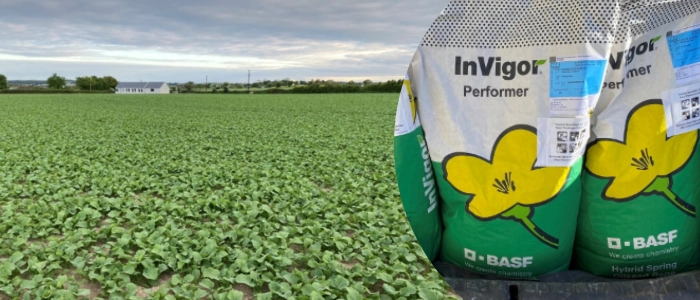
One such variety is PERFORMER, bred by BASF in Germany. First listed on the SOSR Recommended List (UK) in 2020, Performer has not yet been surpassed for its yield potential.

For the above reasons, I chose to grow two fields of PERFORMER SOSR on our own farm in 2022.

The background to my decision to grow Performer was 2-fold; firstly, the fields in question are slow to dry out in spring due to their heavy clay subsoil, and secondly, both fields had been growing spring barley with a number of years, and I was conscious that they would benefit from a break crop.

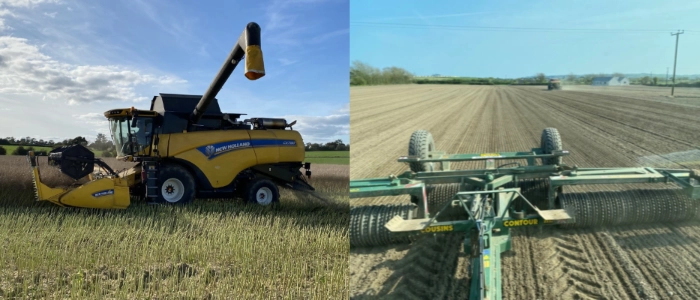
The crop was sown on the 28th of April using a plough and one-pass system. The sowing rate used was 80 seeds/m2 (1 pack to 2.6 Ha) to achieve 70 plants/m2.

NPK was mixed through the seedbed, and the seedbed was rolled immediately to encourage quick and even germination. Butisan S was applied as weed control immediately after rolling. An application of CAN+S was applied once tramlines were visible, bringing the total N used to 150kg/Ha.

The crop grew really quickly, with the vigour of the variety being quite apparent. The crop was monitored for flea beetle, but no control was required.

I desiccated the crop on the 1st of September with Glyphosate. Harvest was delayed due to broken weather. However, we harvested the crop in excellent conditions on the 21st of September, only 19 weeks after it was sown. The crop yielded a very pleasing 4.1T/Ha at 12-12.5% mc. The crop also qualified for the SIM Straw incorporation measure.

Once the crop was harvested, we gave the SOSR stubble one shallow run of a disc harrow to incorporate the chopped straw and also to lessen the risk of any slug survival following the crop.

Overall, PERFORMER spring OSR delivered a high-yielding and profitable crop for me in 2022 and provided an ideal entry crop for the first cereal in good time for autumn sowing. It must be considered as a viable rotational crop-option on farms, especially if a late spring season prevents alternative break crops like winter OSR, beans or oats from being sown.”

Article by John Dunne, Goldcrop Ltd. 

13 April 2023
https://goldcrop.ie/wp-content/uploads/2023/04/Vigor-Final-2.png 400 495 Robert Hawkes https://goldcrop.ie/wp-content/uploads/2025/01/40-Logo-Goldcrop-2.webp Robert Hawkes2023-04-13 17:54:042023-04-14 15:11:53Spring Oilseed Rape | What a Performer | Case Study by John Dunne

Spring Barley Seeding Rate to Achieve Optimum Plant Population

Arable Seeds, Spring Barley

Barley needs plants – How to achieve the optimum plant population for yield.

It goes without saying that when we grow cereal crops, we want as much grain produced per square metre as possible. One of the critical factors in achieving this is the establishment of the optimum number of plants per square metre. The old adage “well sown is half grown” owes its origin to this thought process.
Those who regularly manage winter wheat, winter oilseed rape and to some extent oats will know just how these crops can adapt to compensate for lower plant numbers and still produce an adequate yield. These crops compensate by changing their canopy structure to produce more tillers and larger ears in the case of winter wheat and more branches in the case of oilseed rape. They can also set more seeds and redirect nutrients to fill larger seeds where space allows.
Barley however both winter and spring is different. Barley is quite limited in how it can produce a good yield when plant numbers are compromised. Barley can and will tiller where plants are missing but it cannot compensate with grain number and grain size like wheat. In other words, a high yielding crop of barley needs plants….

What are optimum plant numbers for maximum yield in spring barley?

Trials have shown that 300 plants/m2 for spring barley emerging in March/ early April is around optimum. As the planting date moves later (mid – end of April), this optimum moves a bit higher to approx. 310-320 plants/m2 due to lack of time for tillering.

How do we calculate a seed rate to establish our target plant population?

To calculate the target seed rate, we need to know the seed size (TGW in grams) and make an estimate on what rate of plant establishment we will achieve in the field. TGW will be printed on all Goldcrop supplied seed so that is the easy bit taken care of.
Estimating the establishment rate in field takes a bit more thought. A certain percentage of the seeds in a bag will not grow (certified seed must be at least 85% germination by law). In addition, a certain number of seeds will be lost in the field. Most treated certified spring barley seed will be between 90 & 100% germination. In good planting conditions, one can expect to lose at least 8-10% of seeds in field before emergence. Therefore, it is reasonable to expect to achieve 85% establishment (seed germination and field losses combined) when planting certified spring barley seed in good conditions. Losses can be quite a bit higher if the seed quality or seed bed quality is sub-optimum. I have even observed that soil type can have an impact on establishment rates with shaley soils rarely achieving 90% establishment due to coulter bounce when planting and seeds being covered by small stones. In general, my experience is that plant establishment rates in field are rarely as high as we would like due to an underestimation of in field seed losses. The practice of doing plant counts once the crop has emerged can be useful in getting a feel for what establishment rates you are achieving on your own soil type and will give you confidence in deciding seed rates in future years.

Well-established spring cereal crop 6 April 2023

Well-established spring cereal crop 6 April 2023

Seed Rate Calculation Formula

Seed rate (Kg/Ha) = Target Population (Plants/m2) x TGW (g)
bbbbbbbbbbbbbbbbbbbbbbEstablishment Rate (%)

Example of the seed rate calculation

Target plant population = 300 plants/m2
Seed TGW = 54 grams
Estimated establishment rate (combination of seed germination rate & in field loss) = 85%

300 x 54 = 190kg/Ha (12 stone/acre)
85

Note: allowance should be made where planting barley in very fertile situations such as after long term grass or on peaty soils. High plant numbers in such fertile locations can further increase lodging pressure and it may be advisable to reduce the target plant population.

Proof of the pudding…

In 2011, I decided to conduct a seed rate trial on winter barley. I had read about the requirement to have adequate plant numbers in barley to achieve high yields, I had my doubts as I had regularly seen the great tillering ability of winter barley and felt that it could probably compensate for low plant numbers by tillering.
Two varieties (Cassia and Saffron) were planted in plots at the Goldcrop trial site in Shanagarry to achieve 4 different plant populations in the case of each variety.
The results were illuminating and confirmed to me the limit of barley to compensate for lower plant numbers.

VarietyTarget Plant Population (Plants/m2)Yield (T/Ha at 15%mc)
Saffron2209.1
Saffron2508.8
Saffron3009.9
Saffron3509.0
Cassia2009.5
Cassia25010.0
Cassia30010.5
Cassia3509.8

Article by John Dunne, Goldcrop Ltd. 

6 April 2023
https://goldcrop.ie/wp-content/uploads/2023/04/Spring-Barley-Seed-Rates-1.webp 400 495 Robert Hawkes https://goldcrop.ie/wp-content/uploads/2025/01/40-Logo-Goldcrop-2.webp Robert Hawkes2023-04-06 13:42:052023-04-07 10:37:57Spring Barley Seeding Rate to Achieve Optimum Plant Population
Search Search

Sign Up Croptalk Newsletter

Categories

  • Arable Seeds
  • Beet
  • Brassica Crops
  • Certified Seed
  • Fodder Rape
  • Forage Seed
  • Grassland
  • Maize
  • Oilseed Rape
  • Pasture Profit Index
  • Press Release
  • Red Clover
  • Research
  • Reseeding
  • Spring Barley
  • Spring Oilseed Rape
  • Top Tips
  • White Clover
  • Winter Barley
  • Winter Beans
  • Winter Oilseed Rape
  • Winter Wheat

Product Ranges

  • Arable
  • Forage
  • Crop Protection
  • Goldcrop Amenity
  • Goldcrop Horticulture
  • Fencing
  • Lawn Seed

Locations

Springhill, Carrigtwohill, Co. Cork T45 F685 Ireland

Killavullen, Mallow, Co. Cork P51 CK38 Ireland

Cluide, Dunleer, Co. Louth A92 DK88 Ireland


Product Range

  • Arable
  • Forage
  • Crop Protection
  • Goldcrop Amenity
  • Goldcrop Horticulture
  • Fencing
  • Lawn Seed

Quick Links

  • Agri Sales Team
  • Contact Us
  • Croptalk Blog
  • Our Story
  • Careers
  • Goldcrop Catalogues
  • Book a Speaker
  • Pasture Innovations
  • Accessibility statement
  • Goldcrop Partners Media Portal

Connect

  • Twitter
  • Facebook
  • LinkedIn
  • YouTube
© Copyright - Goldcrop | website & marketing by Method Marketing
  • Link to X Link to X Link to X
  • Link to Facebook Link to Facebook Link to Facebook
  • Link to LinkedIn Link to LinkedIn Link to LinkedIn
  • Link to Youtube Link to Youtube Link to Youtube
Scroll to top Scroll to top Scroll to top